Monte Verde, re-dated
The site that set the earliest date for people in South America, re-examined: 8,200 to 4,200 years old, not 14,500
For three decades one small site in southern Chile held up the earliest date for people in South America. In March 2026 a team that went back to the valley, the first to study it independently of its excavators, argued that the layer behind that date is not 14,500 years old but somewhere between 8,200 and 4,200. This is their paper in plain words, with the Perspective Science published beside it, and three drawings made for this page.
The paper
A mid-Holocene age for Monte Verde challenges the timeline of human colonization of South America
Surovell, Todd A.; Méndez, César; García, Juan-Luis; Lüthgens, Christopher; Thompson, Jay M.; Latorre, Claudio
Science, vol. 391, no. 6791, pp. 1283–1288, 19 March 2026 · doi.org/10.1126/science.adw9217
The Perspective
Rech, Jason
Science, vol. 391, no. 6791, p. 1203, 19 March 2026 · doi.org/10.1126/science.aef9954
The question
When did people first reach South America? For a generation much of the answer rested on Monte Verde, a site in the Lake District of southern Chile dug between 1977 and 1985. Its main layer, Monte Verde II (MV-II), held a small set of stone tools in a peat bed that also preserved wood, bones of extinct animals, seaweed and what looked like cord, read as wooden tools, parts of structures, chewed seaweed. It was dated to about 14,500 years ago. That is nearly 1,500 years before the securely dated Clovis sites of North America, long taken to mark the first Americans, and some 500 years before the oldest unambiguous sites in Alaska and the Yukon, the presumed way in.
In 1997 a party of archaeologists, sceptics among them, visited the site and endorsed it, and Monte Verde became the most widely accepted evidence that people were in the Americas before Clovis. A good deal was built on it. Doubts never quite went away: about how the artefacts, layers and dates were tied together; about old wood or local carbon effects skewing the dates; about plant records that looked more like the Holocene than the Ice Age; about older organic matter washed into the layer; and about a spread of dates too long for the brief stay the excavators described.
What the team did
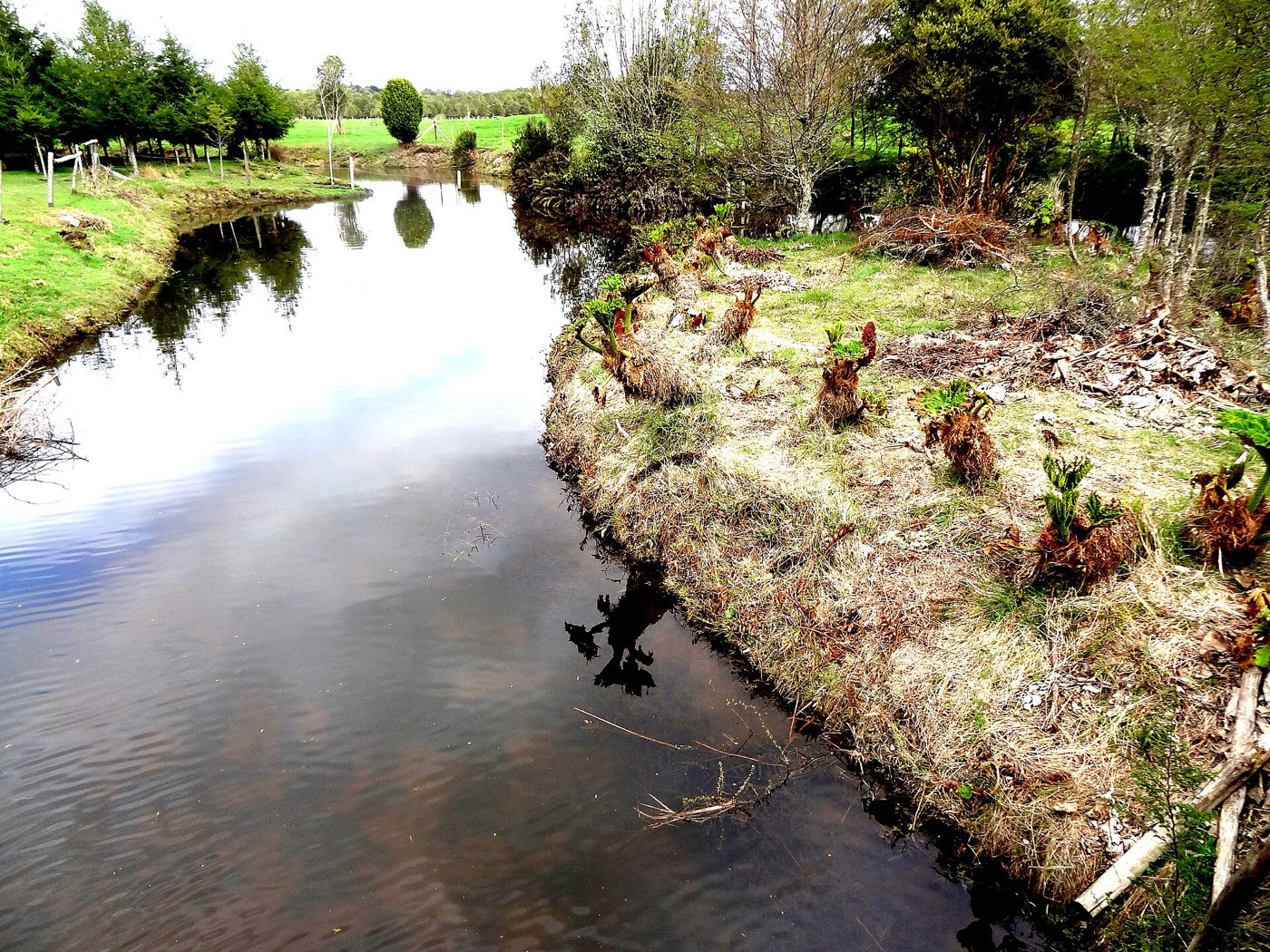
Todd Surovell of the University of Wyoming, Claudio Latorre of the Pontificia Universidad Católica de Chile and colleagues in Chile, the United States and Austria, archaeologists, geologists and dating specialists, made what they describe as the first study of Monte Verde independent of its original investigators in nearly fifty years. They did not re-excavate the site, and could not have repeated the original sections exactly: the part that held the excavated layers has since been lost to erosion.
Instead they described and sampled nine natural exposures, most of them in the banks of Chinchihuapi Creek, the small stream the site lies beside; mapped the valley from drone photographs; and set out their own scheme of layers (stratigraphic units, SU). They dated the layers three ways: radiocarbon on wood, charcoal and organic mud; optically stimulated luminescence (OSL), which dates when grains of sand last saw sunlight; and a volcanic ash, matched by its chemistry to a known, dated eruption. They also radiocarbon-dated a piece of wood the geologist C. V. Haynes collected inside the site area on 9 January 1997.
What they found
- The old terrace (SU1). At the bottom, sands and gravels left by glacial meltwater (SU1a), dated by OSL to about 23,000–14,000 years ago, with wood in them of about 16,450–16,170. On top, with no break between, a bed of wood and charcoal (SU1b) dated 14,750–13,400: the very range of the dates that made Monte Verde famous. Then a dark organic mud (gyttja, SU1c), 11,310–9,720; then a thin ash (SU1d); then today’s soil.
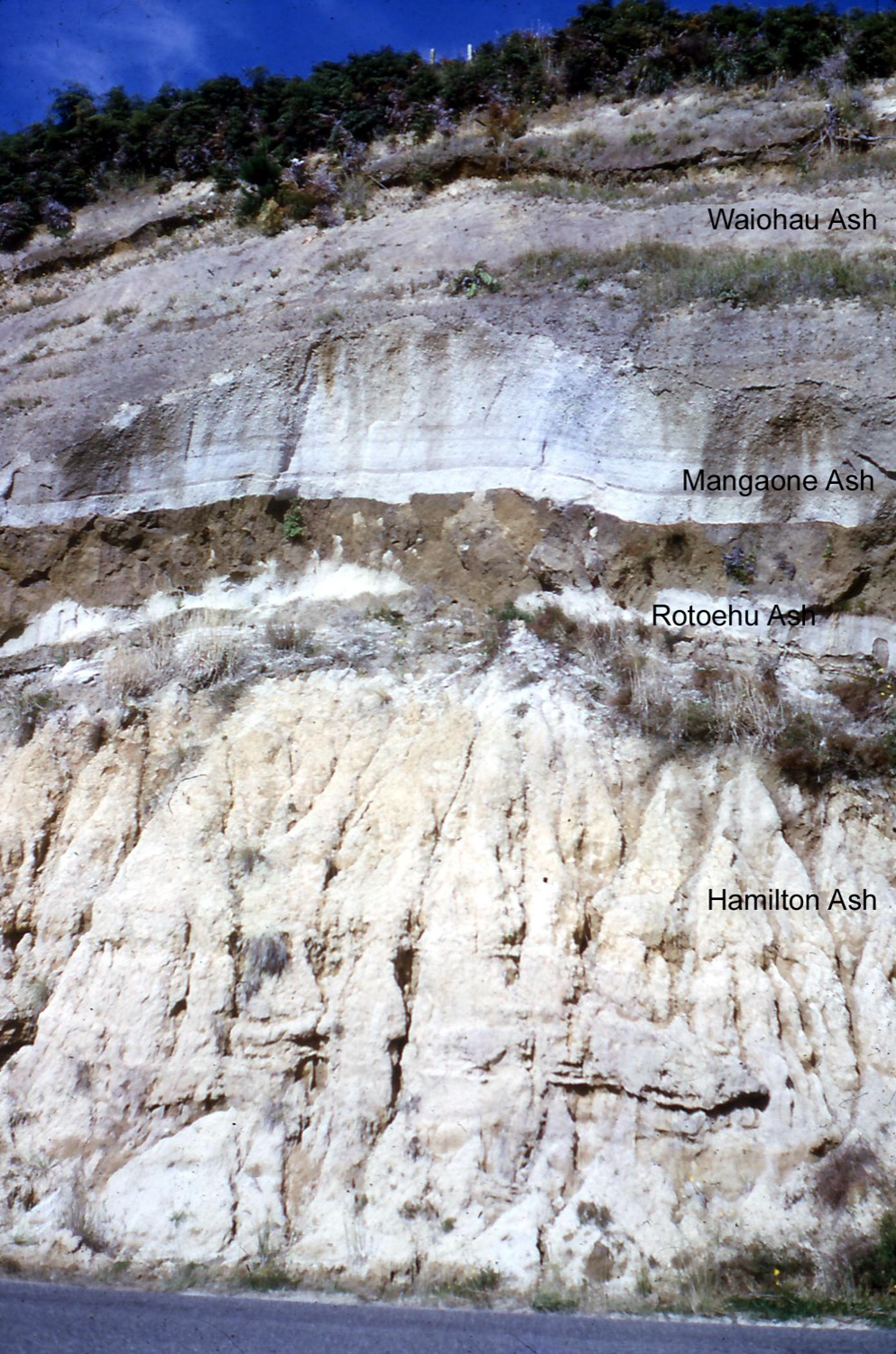
- The ash is the Lepué Tephra, a regional marker dated to 11,000 years ago and formally named only in 2017. It had never been recognised at Monte Verde. Its age and chemistry rule out mistaking it for another ash, or a mixture of ashes.
- The younger deposit (SU2) is a terrace set into the old one: the creek first cut 2.5 to 3 metres down through SU1, the ash included, and then filled the cut. The contact between the two is sharp and plainly erosional, a gap in time. The two even differ in colour, SU1’s sands grey to yellow, SU2’s orange to brown, and SU2 is full of torn-up lumps of older wood and peat. The original excavators placed MV-II at the very base of SU2, on that erosion surface: after the ash.
- Higher in SU2 the dates are Middle Holocene: 7,210 to 4,130 years by radiocarbon on wood and peat, and 8,600 and 2,800 years by OSL on its sand, upstream and downstream of the site.
- Haynes’s 1997 wood, from SU2 just above the contact, is 13,150 years old. The authors read it as Ice Age wood from the wood bed, washed back in. The creek still carries old wood along its channel today.
- The dates already published for the two units overlap by about 7,300 years, which the authors argue only redeposition can explain; and the long spread of dates from MV-II has long been pointed out as hard to square with a short stay.
- The region agrees with a younger age. Charcoal records show a lull in fires during the supposed Ice Age occupation, which suggests no people were there; MV-II’s leaf-shaped (lanceolate) points resemble ones that appear in the region by about 6,400 years ago; its polished slate pieces are common in Middle to Late Holocene shell middens on the coast of the Reloncaví Sound.
How the story now runs
The region’s glacier, the Reloncaví lobe, had retreated from its outermost moraines by 25,000 years ago and collapsed back into the Andes by 18,000 to 17,000. Between 15,000 and 14,000 years ago a temperate rain forest grew in a shallow hollow on the old outwash plain. It gave way to bog as mud and peat filled in, and the ash of 11,000 years ago buried the lot. Then, in an extreme dry, warm phase from 11,000 to 7,600 years ago, and probably helped by the land rising as the weight of ice came off it, the creek cut down 2.5 to 3 metres. When it began to lay down sediment again, after about 8,600 years ago, it swept Ice Age wood, bones of extinct animals and other organic matter from the old terrace into its new deposits.
So the surface MV-II rests on did not exist in the Ice Age: it was made by erosion in the Early Holocene. MV-II, the authors conclude, is Middle Holocene in age, roughly 8,200 to 4,200 years old, and its organic material can give Ice Age radiocarbon dates only because it was moved.
Why it matters
Monte Verde was a fixed point for theories of how people reached the Americas. Because its age seemed too early for people to have walked south through an ice-free corridor in the middle of North America, many researchers turned to a route down the Pacific coast; and the site’s date was used as a check on models built from the genetics of ancient and living people. If MV-II is Middle Holocene, a first entry through the interior of the continent becomes a live possibility again, and the authors argue that Monte Verde’s age should no longer be used to constrain any model.
They do not claim that no one was in the Americas before Clovis; many archaeologists accept that people were. Their point is narrower: Monte Verde no longer shows it, which leaves room for a later first arrival. And they stress how much early sites need independent study and checking.
Things to keep in mind
- The spot with the excavated layers has eroded away. The team could not find the organic layer reported at the base of SU2, and their young dates come from sections near the site, upstream and downstream, not from the excavation itself.
- The artefacts were not dated directly. The conclusion rests on matching layers between exposures and on where the excavators reported MV-II.
- Only one sample, Haynes’s wood, comes from SU2 near the contact at the site.
- The original investigators read the geology differently, and the paper says so. This is an argument in progress, not a settled one.
A second view: Jason Rech’s Perspective
Science ran the paper with a short Perspective by Jason Rech, a geologist at Miami University in Ohio. He recalls what made Monte Verde famous, the preservation of wooden lances, mastodon meat and bone, the stakes and planks of wooden structures, and chewed plants and seaweed, and that its acceptance came with the 1997 visit and with radiocarbon dates on the seaweed, which also came out at 14,500 years. The debate went quiet.
He then puts the new case simply. The landscape is meltwater sand and gravel of 26,000 to 15,500 years ago, capped by the old wood bed, a marsh deposit and the Lepué ash; the floodplain deposit the site rests on is set into that sequence, so it must be younger than 11,000 years, and its own dates fall between 7,200 and 4,100. Without digging the site again, he writes, no one can know the exact age of the surface people lived on; but the deposit is Middle Holocene, so MV-II is Middle Holocene or younger.
Why did it take thirty years? His answer is that the site is remote, and few of the archaeologists, geomorphologists and Ice Age geologists who could have recognised the ash, the exposed wood bed that supplied the old dates, and the abandoned floodplain the site sits on ever went there.
What it means for the first Americans, he says, is unclear, because the field has changed around Monte Verde: other sites now appear older than Clovis, and well-dated finds in North America suggest people by 20,000 years ago. His examples are the footprints at White Sands, New Mexico, dated by Bennett and colleagues in 2021 and supported since by Pigati and colleagues (2023) and Holliday and colleagues (2025); they are on the map above. He draws a lesson both ways: sites that are outliers must be examined critically, since their dating or the evidence for people may be wrong; but scientists should not reject an outlier only because it does not fit the hypothesis they favour. “Science takes time,” he ends, and a clearer picture is decades away, not years.
Words to know
- B.P. (before present): years before 1950, the reference year for radiocarbon dating.
- Pleistocene / Holocene: the Ice Age epoch, and the warmer epoch that began about 11,700 years ago. The Middle Holocene here means about 8,200–4,200 years ago.
- Clovis: a North American culture known for its distinctive spear points, about 13,000 years old. Sites older than Clovis are called “pre-Clovis.”
- Radiocarbon dating: estimating the age of once-living material from how much carbon-14 it has lost.
- OSL (optically stimulated luminescence): a method that dates when sand grains were last exposed to sunlight, that is, when they were buried.
- Tephra: ash and fragments thrown out by a volcanic eruption. A known tephra layer works as a time marker.
- Stratigraphy: the study of the order of rock and sediment layers. Lower layers are normally older.
- Alluvial terrace: a flat step of sediment left by a stream that later cut down below it.
- Erosional contact: a boundary where older layers were worn away before newer ones were laid on top, so time is missing.
- Redeposition: old material eroded from one place and buried again in younger sediment, which makes the younger layer look older than it is.
- Gyttja: dark, organic-rich mud that forms at the bottom of lakes and marshes.
- Terminus ante quem: a “limit before which.” Here the ash shows the mud beneath it must be older than 11,000 years.
Sources
- Surovell, T. A., et al. (2026). A mid-Holocene age for Monte Verde challenges the timeline of human colonization of South America. Science 391, 1283–1288. In the library.
- Rech, J. (2026). A later debut for humans. Science 391, 1203. In the library.
- Bennett, M. R., et al. (2021). Evidence of humans in North America during the Last Glacial Maximum. Science 373, 1528–1531.
- Pigati, J. S., et al. (2023). Independent age estimates resolve the controversy of ancient human footprints at White Sands. Science 382, 73–75. In the library.
- Holliday, V. T., et al. (2025). Paleolake geochronology supports Last Glacial Maximum (LGM) age for human tracks at White Sands, New Mexico. Science Advances 11, eadv4951.
- Waters, M. R., Stafford, T. W., Jr., and Carlson, D. L. (2020). The age of Clovis: 13,050 to 12,750 cal yr B.P. Science Advances 6, eaaz0455.
The drawings were made for this page: the map from Natural Earth (public domain), the cross-section and the timeline from the paper’s text and tables. The photographs are from Wikimedia Commons under the licences in their captions.